
JavaScript 第一章
JavaScript 第一章
显式原型与隐式原型
先贴篇文章。
显式原型:每一个函数在创建之后都会拥有一个名为 prototype 的属性,这个属性指向函数的原型对象。
通过 Function.prototype.bind 方法构造出来的函数是个例外,它没有 prototype 属性
隐式原型:JavaScript 中任意对象都有一个内置属性 [[prototype]],在 ES5 之前没有标准的方法访问这个内置属性,但是大多数浏览器都支持通过 __proto__ 来访问。ES5 中有了对于这个内置属性标准的 Get 方法 Object.getPrototypeOf()。
Object.prototype 这个对象是个例外,它的
__proto__值为 null
**二者的关系**:
- 隐式原型指向创建这个对象的构造函数(constructor)的显式原型;
- 构造函数的
__proto__指向构造函数的原型对象,对于函数来说就是 Function.prototype; - 构造函数的原型对象也有
__proto__,同理它指向构造原型对象的构造函数(即 Function)的原型对象(即 Object.prototype)。
instanceof 内部机制
假设现在有 L instanceof R
function instance_of(L, R) {  // L表示左表达式,R表示右表达式
    var O = R.prototype,  // 取R的显式原型
        L = L.__proto__;  // 取L的隐式原型
    while (true) {
    	if (L === null)
            return false;
        if (O === L)  // 这里重点:当O严格等于L时,返回true
            return true;
        L = L.__proto__;
    }
}
理解下面这张图

你真的了解instanceOf操作符吗?
有了上面instanceof运算符的JS代码和原型继承图,再来理解instanceof运算符易如反掌。先来看几个instanceof复杂用法:
console.log(Object   instanceof Object);  // true
console.log(Function instanceof Function);// true
console.log(Number   instanceof Number);  // false
console.log(String   instanceof String);  // false

console.log(Function instanceof Object);  // true

console.log(Foo      instanceof Function);// true
console.log(Foo      instanceof Foo);     // false
Object instanceof Object// 为了表述清楚,首先区分左侧表达式和右侧表达式 ObjectL = Object, ObjectR = Object; // 下面根据规范逐步推演 O = Object.prototype = Object.prototype; L = Object.__proto__ = Function.prototype; // 注意这一步 // 第一次判断 O != L; // 循环查找L是否还有__proto__ L = Function.prototype.__proto__ = Object.prototype; // 第二次判断 O == L; // 返回trueFunction instanceof Function// 为了表述清楚,首先区分左侧表达式和右侧表达式 FunctionL = Function, FunctionR = Function; // 下面根据规范逐步推演 O = FunctionR.prototype = Function.prototype; L = FunctionL.__proto__ = Function.prototype; // 第一次判断 O == L; // 返回trueFoo instanceof Foo// 为了表述清楚,首先区分左侧表达式和右侧表达式 FooL = Foo, FooR = Foo; // 下面根据规范逐步推演 O = FooR.prototype = Foo.prototype; L = FooL.__proto__ = Function.prototype; // 第一次判断 O != L; // 循环查找L是否还有__proto__ L = Function.prototype.__proto__ = Object.prototype; // 第二次判断 O != L; // 再次循环查找L是否还有__proto__ L = Object.prototype.__proto__ = null; // 第三次判断 L == null // 返回false
创建对象的方法汇总
工厂模式
function createPerson(name) {
    var o = new Object();
    o.name = name;
    o.getName = function() {
        console.log(this.name);
    }
    return o;
}
var p1 = createPerson("ghm");
缺点:对象无法识别,因为所有实例都指向一个原型。
构造函数模式
function Person(name) {
    this.name = name;
    this.getName = function() {
        console.log(this.name);
    };
}
var p1 = new Person("ghm");
优点:实例可以识别为一个特定的类型
缺点:每次创建实例时,每个方法都要被创建一次
原型模式
function Person(name) {

}
Person.prototype.name = "ghm";
Person.prototype.getName = function() {
    console.log(this.name);
}
var p1 = new Person();
优点:方法不会被重建
缺点:所有属性和方法共享;不能初始化参数
组合模式
function Person(name) {
    this.name = name;
}
Person.prototype = {
    constructor: Person,
    getName: function() {
        console.log(this.name);
    }
};
var p1 = new Person();
优点:该共享的共享,该私有的私有,使用最广泛的方式
缺点:有的人就是希望全部都写在一起,即更好的封装性
动态原型模式
function Person(name) {
    this.name = name;
    if (typeof this.getName != "function") {
        Person.prototype.getName = function() {
            console.log(this.name);
        }
    }
}
var p1 = new Person("ghm");
寄生构造函数模式
function Person(name) {
    var o = new Object();
    o.name = name;
    o.getName = function() {
        console.log(this.name);
    }
    return o;
}
var p1 = new Person("ghm");
console.log(p1 instanceof Person);  // false
console.log(p1 instanceof Object);  // true
这样方法可以在特殊情况下使用,比如我们想创建一个具有额外方法的特殊数组,但是又不想直接修改Array构造函数。在可以使用其他模式的情况下,不要使用这种模式。
稳妥构造函数模式
function person(name) {
    var o = new Object();
    o.sayName = function() {
        console.log(name);
    };
    return o;
}
var p1 = person("ghm");
p1.sayName();  // ghm
p1.name = "kevin";
p1.sayName();  // ghm
console.log(p1.name);  // "kevin"
所谓稳妥对象,指的是没有公共属性,而且其方法也不引用this的对象。
稳妥对象最适合在一些安全的环境中。稳妥构造函数模式也跟工厂模式一样,无法识别对象所属类型。
继承的方式
继承的方法汇总
1、原型链继承
function Parent() {
  this.name = 'ghm';
}
Parent.prototype.getName = function() {
    console.log(this.name);
}
function Child() {

}
Child.prototype = new Parent();
var child1 = new Child();
console.log(child1.getName());  // ghm
问题:
- 引用类型的属性被所有实例共享
function Parent () {
    this.names = ['kevin', 'daisy'];
}
function Child () {

}
Child.prototype = new Parent();

var child1 = new Child();
child1.names.push('yayu');
console.log(child1.names); // ["kevin", "daisy", "yayu"]

var child2 = new Child();
console.log(child2.names); // ["kevin", "daisy", "yayu"]
- 在创建Child的实例时,不能向Parent传参
2、 借用构造函数
function Parent() {
    this.names = ["kevin", "daisy"];
}
function Child() {
    Parent.call(this);
}

var child1 = new Child();
child1.names.push("yayu");
console.log(child1.names);  // ["kevin", "daisy", "yayu"]

var child2 = new Child();
console.log(child2.names);  // ["kevin", "daisy"]
优点:
避免了引用类型的属性被所有实例共享
可以在Child中向Parent传参
```js
function Parent(name) {
    this.name = name;
}
function Child(name) {
    Parent.call(this, name);
}

var child1 = new Child('kevin');
console.log(child1.name);  // kevin

var child2 = new Child('daisy');
console.log(child2.name);  // daisy
```
缺点:方法都在构造函数里定义,每次创建实例都会创建一遍方法。
3、 组合继承
function Parent(name) {
    this.name = name;
    this.colors = ['red', 'blue', 'green'];
}
Parent.prototype.getName = function() {
    console.log(this.name);
}

function Child(name, age) {
  Parent.call(this, name);
    this.age = age;
}
Child.prototype = new Parent();
Child.prototype.constructor = Child;

var child1 = new Child('kevin', '18');
child1.colors.push('black');
console.log(child1.name); // kevin
console.log(child1.age); // 18
console.log(child1.colors); // ["red", "blue", "green", "black"]

var child2 = new Child('daisy', '20');
console.log(child2.name); // daisy
console.log(child2.age); // 20
console.log(child2.colors); // ["red", "blue", "green"]
优点:融合原型链继承和构造函数继承的优点,是 JavaScript 中最常用的继承模式。
4、 原型式继承
function createObj(o) {
    function F() {}
    F.prototype = o;
    return new F();
}
缺点:包含引用类型的属性值始终会共享相应的值,这点跟原型链继承一样。
var person = {
    name: 'kevin',
    friends: ['daisy', 'kelly']
}
var person1 = createObj(person);
var person2 = createObj(person);

person1.name = 'person1';
console.log(person2.name);  // kevin

person1.firends.push('taylor');
console.log(person2.friends);  // ["daisy", "kelly", "taylor"]
注意:修改person1.name的值,person2.name的值并未发生改变,并不是因为person1和person2有独立的 name 值,而是因为person1.name = 'person1',给person1添加了 name 值,并非修改了原型上的 name 值。
5、 寄生式继承
创建一个仅用于封装继承过程的函数,该函数在内部以某种形式来做增强对象,最后返回对象。
function createObj(o) {
    var clone = Object.create(o);
    clone.sayName = function() {
    console.log('hi');
    }
    return clone;
}
缺点:跟借用构造函数模式一样,每次创建对象都会创建一遍方法。
6、 寄生组合式继承
组合继承最大的缺点是会调用两次父构造函数。
如果不使用Child.prototype = new Parent(),而是间接地让Child.prototype和child1都有一个属性为colors,属性值为['red', 'blue', 'green']。
如何间接的让Child.prototype访问到Parent.prototype呢?
function Parent (name) {
    this.name = name;
    this.colors = ['red', 'blue', 'green'];
}
Parent.prototype.getName = function () {
    console.log(this.name)
}

function Child (name, age) {
    Parent.call(this, name);
    this.age = age;
}

// 关键的三步
var F = function() {};
F.prototype = Parent.prototype;
Child.prototype = new F();

var child1 = new Child("kevin", 18);
最后封装一下这个继承方法:
function create(o) {
  function F() {}
    F.prototype = o;
    return new F();
}

function prototype(child, parent) {
    child.prototype = create(parent.prototype);
    child.prototype.constructor = child;
}

// 当使用的时候
prototype(Child, Parent);
引用《JavaScript高级程序设计》中对寄生组合式继承的夸赞就是:
这种方式的高效率体现在它只调用一次Parent构造函数,并且因此避免了在Parent.prototype创建不必要的、多余的属性。与此同时,原型链还能保持不变;因此,还能够正常使用instanceof和isPrototypeOf。开发人员普遍认为寄生组合式继承是引用类型最理想的继承范式。
一道跟原型动态性有关的题
function F() {}
function O() {}

O.prototype = new F();
var obj = new O();

console.log(obj instanceof O);
console.log(obj instanceof F);
console.log(obj.__proto__ === O.prototype);
console.log(obj.__proto__.__proto__ === F.prototype);
答案是:true, true, true, true
接着再来看:
function F() {}
function O() {}

var obj = new O();
O.prototype = new F();

console.log(obj instanceof O);
console.log(obj instanceof F);
console.log(obj.__proto__ === O.prototype);
console.log(obj.__proto__.__proto__ === F.prototype);
答案完全相反:false, false, false, false
这里的坑点在于重写了原型对象!!!
重写原型对象切断了现有原型与任何之前已经存在的对象实例之间的联系,他们引用的仍然是最初的原型。
JavaScript 中的 == 运算符
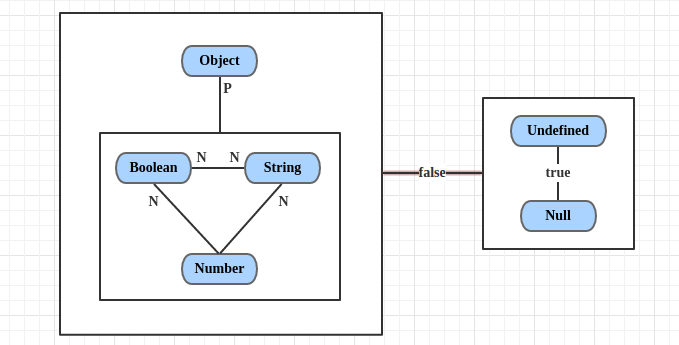
一张图概括如上。(也可参考这篇文章)
转换规则如下:
- 字符串和数字之间的比较,是将字符串转换为数字
- 其他类型和布尔类型的比较,是将布尔类型转换为数字
- 在
==中null和undefined相等(他们也与自身相等),除此之外其他值都不存在这种情况 - 对象和非对象之间的比较,调用
ToPrimitive将对象转换为原始类型,ToPrimitive操作规则如下:
**
ToPrimitive(obj)**等价于:先计算obj.valueOf(),如果为原始值,则返回此结果; 否则,计算obj.toString(),如果结果是原始值,则返回此结果;否则,抛出异常。
var 和 let 区别
- ES6可以用let定义块级作用域变量
- let配合for循环的独特应用
- let没有变量提升和暂时性死区
- let变量不能重复声明
Promise
具体看这里
async/await
async 函数
函数的返回值为 Promise 对象
Promise 对象的结果由 async 函数执行的返回值决定
await 函数
await 右侧的表达式一般为 Promise 对象,但也可以是其它的值
如果表达式是 Promise 对象,await 返回的是 Promise 成功的值
如果表达式是其它值,直接将此值作为 await 的返回值
⚠️ 注意
await 必须写在 async 函数中,但 async 函数中可以没有 await
如果 await 的 Promise 失败了,就会抛出异常,需要通过 try...catch 来捕获处理
事件循环机制
https://segmentfault.com/a/1190000016022069
宏任务
| # | 浏览器 | Node |
|---|---|---|
I/O | ✅ | ✅ |
setTimeout | ✅ | ✅ |
setInterval | ✅ | ✅ |
setImmediate | ❌ | ✅ |
requestAnimationFrame | ✅ | ❌ |
微任务
| # | 浏览器 | Node |
|---|---|---|
process.nextTick | ❌ | ✅ |
MutationObserver | ✅ | ❌ |
Promise.then catch finally | ✅ | ✅ |
process.nextTick优先级高于promise.then
setTimeout优先级高于setImmediate
console.log('a');
setTimeout(() => {
    console.log('b');
}, 0);
console.log('c');
Promise.resolve().then(() => {
    console.log('d');
})
.then(() => {
    console.log('e');
});
console.log('f');
this 的指向
- 在调用函数时使用
new关键字,函数内的this是一个全新的对象 - 如果
apply、call或bind方法用于调用、创建一个函数,函数内部的this就是作为参数传入这些方法的对象 - 当函数作为对象里的方法被调用时,函数内的
this是调用该函数的对象。 - 如果调用函数不符合上述规则,那么
this的值指向全局对象。非严格模式下,this指向window对象,但在严格模式下,this的值是undefined。 - 如果符合上述多个规则,则较高的规则(从上到下依次减小)将决定
this的值 - 如果函数是箭头函数,将忽略上面的所有规则,
this被设置为它被创建时的上下文
类数组转数组
let arrayLike = {0: 'name', 1: 'age', 2: 'sex', length: 3 };
// 1.slice
Array.prototype.slice.call(arrayLike);  // ["name", "age", "sex"]
// 2.splice
Array.protrotype.splice.call(arrayLike, 0);  // ["name", "age", "sex"]
// 3.ES6 Array.from
Array.from(arrayLike);  // ["name", "age", "sex"]
// 4.apply
Array.prototype.concat.apply([], arrayLike);  // ["name", "age", "sex"]
改写数组的push方法,保持原来的逻辑之外,再添加一个console.log(arguments)在控制台打印
const push = Array.prototype.push;
Array.prototype.push = ((val) => {
  console.log(val);
  push.call(this, val);
})
哪些操作会导致内存泄漏
JS内存泄漏指对象在不需要使用它时仍然存在,导致占用的内存不能够被使用或回收。
- 未使用var声明的全局变量
- 闭包函数
- 循环引用(两个对象相互引用)
- 控制台日志(console.log)
- 移除存在事件绑定的DOM元素(IE)
JS调用函数有哪几种方式
- 作为对象的方法调用
- 函数直接调用
- 作为构造函数调用
- 使用call/apply
- 使用bind
数组随机化
const shuffle = (arr) => {
  let currentIndex = arr.length, temporaryValue, randomIndex;

  while (currentIndex !== 0) {
    randomIndex = Math.floor(Math.random() * currentIndex);
    --currentIndex;

    // swap currentIndex and randomIndex
    temporaryValue = arr[currentIndex];
    arr[currentIndex] = arr[randomIndex];
    arr[randomIndex] = temporaryValue;
  }

  return arr;
};
数组扁平化 + 去重
先来扁平化。
// 深度策略
function flattern(arr) {
  return arr.reduce((prev, cur) => prev.concat(Array.isArray(cur) ? flattern(cur) : cur), []);
}
// 广度策略
function flattern(arr) {
  while (arr.some(item => Array.isArray(item))) {
    arr = [].concat(...arr);
  }
  return arr;
}
function flattern(arr) {
  return arr.toString().split(',').map((item) => +item);
}
function iterTree(tree) {
  if (Array.isArray(tree)) {
    for (let i = 0; i < tree.length; ++i) {
      yield* iterTree(tree[i]);
    }
  } else {
    yield tree;
  }
}
再来去重。
function unique(arr) {
  return arr.reduce((prev, cur) => prev.includes(cur) ? prev : [...prev, cur], []);
}
function unique(arr) {
  return array.filter((item, index, array) => array.indexOf(item) === index);
}
function unique(arr) {
  let obj = {};
  return arr.filter((item, index, arr) => {
    return obj.hasOwnProperty(typeof item + JSON.stringify(item)) ? false : (obj[typeof item + JSON.stringify(item)] = true);
  });
}
ES6 的去重方法:
let unique = (arr) => [...new Set(arr)];
function unique(arr) {
  let seen = new Map();
  return arr.filter((a) => !seen.has(a) && seen.set(a, 1));
}
实现call、apply
Function.prototype.call = function(context) {
  context = context || window;
  context.fn = this;

  let args = [];
  for (let i = 1; i < arguments.length; ++i) {
    args.push('arguments[' + i + ']');
  }

  let result = eval('context.fn(' + args + ')');

  delete context.fn;
  return result;
}
Function.prototype.apply = function(context, arr) {
  context = context || window;
  context.fn = this;

  let result;
  if (!arr) {
    result = context.fn();
  } else {
    let args = [];
    for (let i = 0, len = arr.length; i < len; ++i) {
      args.push('arr[' + i + ']');
    }
    result = eval('context.fn(' + args + ')');
  }
  delete context.fn;
  return result;
}
实现bind
Function.prototype.bind = function(ctx) {
  let self = this;
  let args = Array.prototype.slice.call(arguments, 1);

  let fBound = function() {
    let bindArgs = Array.prototype.slice.call(arguments);
    return self.apply(this instanceof fBound ? this : ctx, args.concat(bindArgs));
  }

  fBound.prototype = self.prototype;
  return fBound;
}
实现new
- 首先新建一个对象
- 然后将对象的原型指向
fn.prototype - 然后
Person.apply(obj) - 返回这个对象
function New(fn) {
  let res = {};
  res.prototype = fn.prototype;

  let ret = fn.apply(res, Array.prototype.slice.call(arguments, 1));

  if ((typeof ret == "function" || typeof ret == "object") && ret !== null) {
    return ret;
  }

  return res;
}
实现浅拷贝和深拷贝
浅拷贝的实现
function shallowCopy(obj) {
  if (typeof obj !== 'object') return;
  let newObj = obj instanceof Array ? [] : {};
  for (let key in obj) {
    if (obj.hasOwnProperty(key)) newObj[key] = obj[key];
  }
  return newObj;
}
深拷贝的实现
function deepCopy(obj) {
  if (typeof obj !== 'object') return;
  let newObj = obj instanceof Array ? [] : {};
  for (let key in obj) {
    if (obj.hasOwnProperty(key)) newObj[key] = typeof obj[key] === "object" ? deepCopy(obj[key]) : obj[key];
  }
  return newObj;
}
实现原生 Ajax
发送GET请求
let request;
if (window.XMLHttpRequest)
  request = new XMLHttpRequest();
else
  request = new ActiveXObject('Microsoft.XMLHTTP');

request.onreadystatechange = () => {
  if (request.readyState === 4 && request.status === 200)
    cb(request.response);
}

request.open('GET', url);
request.send();
发送POST请求
let request;
// 1.创建一个XMLHttpRequest对象
if (window.XMLHttpRequest)
  request = new XMLHttpRequest();
else
  request = new ActiveXObject('Microsoft.XMLHTTP');

// 2.设置回调监听
request.onreadystatechange = () => {
  if (request.readyState == 4 && request.status == 200)
    callback(request.responseText);
}

// 3.打开一个链接
request.open('POST', url);

// 4.设置请求头(GET没有该步骤)
request.setRequestHeader('Content-type', 'application/x-www-form-urlencoded');

// 5.发送请求(参数: 具体发送的值)
request.send('name=value&age=12');
防抖与节流
- 先来讲讲防抖:你尽管触发事件,但是我一定在事件触发n秒后再执行,如果你在一个事件触发的n秒内又触发了这个事件,那我就以新的事件的事件为标准,n秒后才执行,总之,就是要等你触发完事件n秒内不再触发事件。
function debounce(func, wait) {
  let timeout;
  return function() {
    let ctx  = this;
    let args = arguments;

    clearTimeout(timeout);
    timeout = setTimeout(function() {
      func.apply(ctx, args);
    }, wait);
  }
}
- 再来介绍节流:如果你持续触发事件,每隔一段时间,只执行一次事件。有两种主流的实现方式,一种是时间戳,一种是定时器。
时间戳
function throttle(func, wait) {
  let ctx, args;
  let prev = 0;

  return function() {
    let now = Date.now();
    ctx  = this;
    args = arguments;
    if (now - prev > wait) {
      func.apply(ctx, args);
      prev = now;
    }
  }
}
定时器
function throttle(func, wait) {
  let ctx, args;
  let timeout;

  return function() {
    ctx  = this;
    args = arguments;
    if (!timeout) {
      timeout = setTimeout(function() {
        timeout = null;
        func.apply(ctx, args);
      }, wait)
    }
  }
}
简述同步和异步的区别
同步是阻塞模式,异步是非阻塞模式。
- 同步就是指一个进程在执行某个请求的时候,若该请求需要一段时间才能返回信息,那么这个进程将会一直等待下去,知道收到返回信息才继续执行下去
- 异步是指进程不需要一直等下去,而是继续执行下面的操作,不管其他进程的状态。当有消息返回时系统会通知进程进行处理,这样可以提高执行的效率
一道面试题引发的思考
const obj = { selector: { to: { toutiao: "FE Coder"} }, target: [1, 2, { name: 'byted'}]};

get(obj, 'selector.to.toutiao', 'target[0]', 'target[2].name');
// [ 'FE Coder', 1, 'byted']
实现一个get函数,使得上面的输出成立。
首先,可以通过构建一个Function解决这个问题(Function的详细介绍)。
function get(data, ...args) {
  return args.map(item => (new Function('data', `try {return data.${item}} catch(e) {}`))(data));
}
还可以使用正则表达式来进行处理:
function get (data, ...args) {
  return args.map(item => {
    let res = data;
    item.replace(/\[/g, '.')
        .replace(/\]/g, '')
        .split('.')
        .map(path => res = res && res[path]);
    return res;
  });
}
也可以用eval,不过不推荐使用。
function get(data, ...args) {
  return args.map(item => eval('data.' + item));
}
正则实现千位分隔符
let str = "1312567.903000";
let reg = /\B(?=(\d{3})+\.)/g;

console.log(str.replace(reg, ","));
或者
let str = "1312567.903000";
str = str.replace(/(\d)(?=(\d{3})+\.)/g, function($0, $1) {
  return $1 + ',';
})

console.log(str);
还可以
let str = 1312567.903000;
str.toLocaleString();  // 不过这种方法会自动进行四舍五入
注:如果不带小数点的话就把\.换成$
正则实现转换下划线命名法和驼峰命名法
下划线命名法 -> 驼峰命名法
function toHump(str) {
  return str.replace(/\_([a-z])/g, function($0, $1) {
    return $1.toUpperCase();
  });
}
驼峰命名法 -> 下划线命名法
function toLine(str) {
  return str.replace(/[A-Z]/g, function($0) {
    return '_' + $0.toLowerCase();
  });
}
下面的代码输出什么?为什么?
Function.prototype.a = 'a';
Object.prototype.b = 'b';
function Person() {};
var p = new Person();
console.log('p.a: ' + p.a);  // undefined,因为new出来的p是一个对象
console.log('p.b: ' + p.b);  // b
下面的代码输出什么?为什么?
async function async1() {
  console.log("a");
  await async2();
  console.log("b");
}
async function async2() {
	console.log("c");
}
console.log("d");
setTimeout(function () {
  console.log("e");
}, 0);
async1();
new Promise(function (resolve) {
  console.log("f");
  resolve();
}).then(function () {
  console.log("g");
});
console.log("h");
// d a c f h b g e
async/await本质上还是基于Promise的一些封装,而Promise是属于微任务的一种。所以在使用await关键字与Promise.then效果类似:
setTimeout(_ => console.log(5))

async function main() {
	console.log(1);
  await side();
  console.log(4);
}

async function side() {
  console.log(2);
}

main();

console.log(3);
// 1 2 3 4 5
async函数在await之前的代码都是同步执行的,可以理解为await之前的代码属于new Promise时传入的代码,await之后的所有代码都是在promise.then中的回调。await后的代码也会立即执行。
为什么0.1 + 0.2 不等于 0.3 ?
首先我们要知道JS是如何表示数字的?
JS使用Number类型表示数字(整数和浮点数),遵循IEEE 754标准通过64位来表示一个数字,如下图。
- 第0位:符号位,0表示正数,1表示负数(s)
- 第1位到第11位:存储指数部分(e)
- 第12位到第63位:存储尾数部分(即有效数字f)
JS最大安全数是Number.MAX_SAFE_INTEGER == Math.pow(2, 53) - 1,而不是Math.pow(2, 52) - 1,why?尾数部分不是只有52位吗?
这是因为二进制表示有效数字总是1.xx...xx的形式,尾数部分f在规约形式下第一位默认为1(省略不写,xx...xx为尾数部分f,最长52位)。因此,JS提供的有效数字最长为53个二进制位(64位浮点的后52位 + 被省略的1位)。
其次我们还要清楚运算时发生了什么?
首先,计算机无法直接对十进制的数字进行运算,这是硬件物理特性已经决定的。这样运算就分成了两个部分:先按照IEEE 754转成相应的二进制,然后对阶运算。
1. 进制转换
0.1 和 0.2 转换成二进制后会无限循环。
0.1 -> 0.0001100110011001...(无限循环)
0.2 -> 0.0011001100110011...(无限循环)
但是由于IEEE 754尾数位限制,需要将后面多余的位截掉。这样在进制转换的时候精度已经损失。
2. 对阶运算
由于指数位数不相同,运算时需要对阶运算,这部分也可能产生精度损失。按照上面两步运算(包括两步的精度损失),最后的结果是:
0.0100110011001100110011001100110011001100110011001100
转换为十进制结果就是0.30000000000000004。
用setTimeout实现setInterval
function mySetInterval(fn, wait, count) {
	function interval() {
		if (typeof count == "undefined" || count --> 0) {  // 这里的 --> 其实是先判断count是否大于0,然后再自减一(第一次看到这种写法。。。)
			setTimeout(interval, wait);
			try {
				fn();
			} catch (e) {
				count = 0;
        throw e.toString();
			}
		}
	}
	setTimeout(interval, wait);
}
Fetch和Ajax的区别
Ajax:利用的是XMLHttpRequest对象来请求数据的。
Fetch:window对象的一个方法,主要特点是:
- 第一个参数是URL
- 第二个参数可选,可以控制不同的init对象
- 使用了es6的promise对象
fetch(url).then(function(response) {
  return response.json();  // 执行成功第一步
}).then(function(val) {
    // 执行成功第二步
}).catch(function(err) {
    // 中途任何地方出错都会在这里捕捉到
})
注意:fetch的第二个参数中
- 默认的请求为get请求,可以使用
method: post来进行配置 - 第一步中的response有许多方法:
json()、text()、formData() - fetch跨域的时候默认不会带cookie,需要手动指定:
credentials: 'include'
- fetch和ajax的主要区别
- 当接收到一个代表错误的HTTP状态码时,从fetch()返回的Promise不会被标记为reject,即便该HTTP响应的状态码是404或500。相反,它会将Promise状态标记为resolve(但是会将resolve的返回值的
ok属性设置为false),仅当网络故障时或请求被阻止时,才会标记为reject。 - 在默认情况下fetch不会从服务器端发送或接收任何cookies。
前端模块化
JS基本类型的属性赋值问题
在某些情况下基本类型会表现的“很像”对象类型,使得用户可以像使用对象一样去使用基本类型数据。某些情况主要指“对属性的赋值和读取”。
当你尝试将名为"bar"的属性分配给变量foo时,像这样:
foo.bar = 'abc';
那么结果取决于foo的值的类型:
- 如果foo的值的类型为undefined或null,那么将抛出一个错误
- 如果foo的值的类型是Object类型,那么将在对象foo上定义一个命名的属性”bar",并且其值将被设置为"abc"
- 如果foo的值是Number、String或Boolean类型,那么变量foo不会以任何方式改变。在这种情况下,上面的赋值操作将是一个NOP
以Number类型为例:
var a = 12.3;
console.log(a.toFixed(3)); // 输出"12.300"

a.foo = 'bar';  // 不报错
console.log(a.foo);  // 输出undefined
上述代码说明,基本类型可以像对象类型一样使用,包括访问其属性、对其属性赋值(尽管实际上不起作用,但是形式上可以)。
之所以能这样去使用基本类型,是因为JavaScript引擎内部在处理对某个基本类型a进行形如a.sth的操作时,会在内部临时创建一个对应的包装类型(对数字类型来说就是Number类型)的临时对象,并把对基本类型的操作代理到这个临时对象身上, 使得对基本类型的属性访问看起来像对象一样。但是在操作完成后,临时对象就被丢弃了,下次再访问时,会重新建立临时对象,当然对之前的临时对象的修改都不会有效了。
判断对象是否为空对象
方法1:
for...in...遍历属性,为真则为空对象,否则为非空对象。for (var key in obj) { return false; } return true;方法2:通过
JSON.stringify()来判断。if (JSON.stringify(obj) == "{}") { return true; } return false;方法3:ES6新增的方法
Object.keys(),Object.keys()会返回一个由一个给定对象的自身可枚举属性组成的数组。Object.keys(obj).length === 0;
如何判断两个对象相等
function equals(x, y) {
  let f1 = x instanceof Object;
  let f2 = y instanceof Object;
  if (!f1 || !f2) return x === y;
  if (Object.keys(f1).length !== Object.keys(f2).length) return false;
  let newX = Object.keys(x);
  for (let value of newX) {
    let a = x[value] instanceof Object;
    let b = y[value] instanceof Object;
    if (a && b) {
      equals(x[value], y[value]);
    } else if (x[value] !== y[value]) {
      return false;
    }
  }
  return true;
}
什么是函数柯里化?实现sum(1)(2)(3)返回结果是1,2,3之和
函数柯里化是把接收多个参数的函数变换成接受一个单一参数(最初函数的第一个参数)的函数,并且返回接受余下的参数而且返回结果的新函数的技术。
function sum(a) {
  return function(b) {
    return function(c) {
      return a + b + c;
    }
  }
}
console.log(sum(1)(2)(3));  // 6
引申:实现一个curry函数,将普通函数柯里化
function curry(fn, args = []) {
  return function() {
    let rest = [...args, ...arguments];
    if (rest.length < fn.length) {
      return curry.call(this, fn, rest);
    } else {
      return fn.apply(this, rest);
    }
  }
}

function sum(a, b, c) {
  return a + b + c;
}

let sumFn = curry(sum);
console.log(sumFn(1)(2)(3));  // 6
console.log(sumFn(1)(2, 3));  // 6
使用Promise封装简单Ajax方法
GET
function getJSON(url) {
  return new Promise((resolve, reject) => {
    let xhr = new XMLHttpRequest();
    xhr.onreadystatechange = function() {
      if (this.readyState === 4) {
        if (this.status === 200) {
          resolve(JSON.parse(this.responseText), this);
        } else {
          let resJson = { code: this.status, response: this.response };
          reject(resJson, this);
        }
      }
    }
    xhr.open("GET", url, true);
    xhr.send();
  })
}
POST
function postJSON(url, data) {
  return new Promise((resolve, reject) => {
    let xhr = new XMLHttpRequest();
    xhr.onreadystatechange = function() {
      if (this.readyState === 4) {
        if (this.status === 200) {
          resolve(JSON.parse(this.responseText), this);
        } else {
          let resJson = { code: this.status, response: this.response };
          reject(resJson, this);
        }
      }
    }
    xhr.open("POST", url, true);
    xhr.setRequestHeader("Content-type", "application/x-www-form-urlencoded");
    xhr.send(JSON.stringify(data));
  })
}